Quick answer: Yes. An industrial vacuum cleaner can be matched to automation equipment as an at-source dust extraction unit, a machine-side collector, or part of a centralized vacuum line. The correct match depends on the material, pickup-point geometry, hose diameter and length, required airflow and vacuum, filtration, duty cycle, power supply, dust-discharge method, and the start/stop or alarm signals required by the machine control system.
JFURTHER’s three-phase JF3, JFK5 and JFL9 series are practical starting points for automated production lines because the catalog specifies turbine-driven operation and 24-hour continuous-duty capability. The final system should still be engineered around the customer’s real process rather than selected by motor power alone.
What Does “Matching an Industrial Vacuum Cleaner to Automation Equipment” Mean?
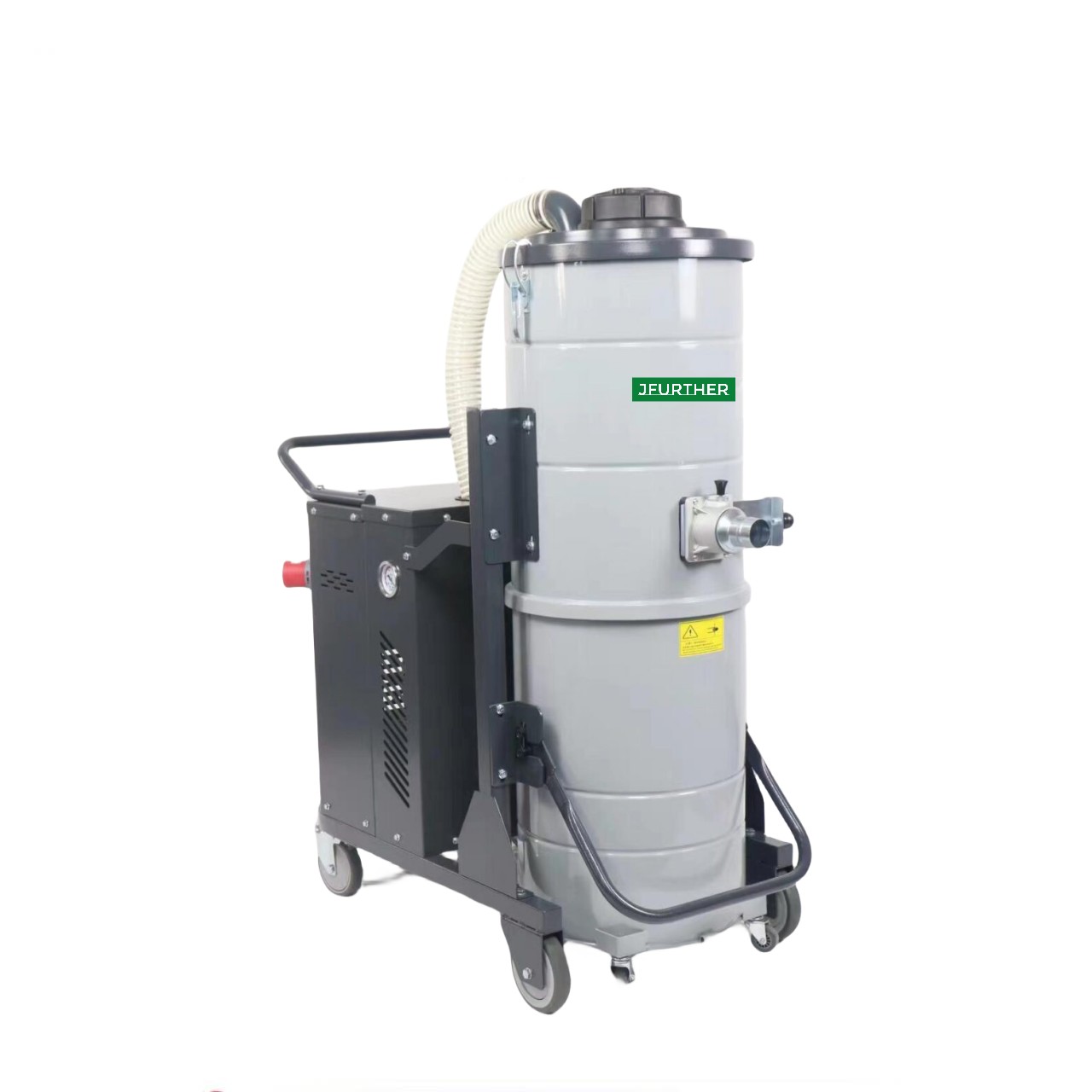
In this application, the vacuum cleaner is normally not a floor-cleaning robot. It is a fixed or mobile dust-extraction unit connected to a processing machine, robot cell, conveyor, packaging line, machine tool, filling station or other automated equipment. Its job is to capture dust, chips, powder or process waste close to the source before the material spreads through the workshop or affects the product.
A successful integration has four parts:
- Mechanical matching: the suction port, hose, branch fittings and mounting space fit the machine.
- Air-performance matching: airflow and negative pressure remain sufficient after hose and duct losses.
- Filtration and collection matching: the filter and dust container suit the particle size, dust loading and disposal method.
- Control matching: start/stop, interlock, running status, filter alarm or other signals are defined for the automation system.
This is why an industrial vacuum cleaner for automation equipment should be selected from process data, not from a generic “strong suction” description.
Which JFURTHER Series Fits an Automated Production Line?
The table below summarizes the relevant configurations in JFURTHER’s May 21, 2024 industrial vacuum cleaner catalog. Specifications should be reconfirmed for the exact voltage, filter and control configuration before ordering.
| Series | Best starting point | Catalog power | Max. vacuum | Max. airflow | Collection | Automation-relevant features |
|---|---|---|---|---|---|---|
| JF3 | Heavy dust loading, several pickup points or higher-resistance pipework | 3.0-7.5 kW, 380 V three-phase | 260-320 mbar | 320-530 m³/h | 100 L | 24-hour turbine operation; manual, blowback or electric filter cleaning; selected H-class HEPA configurations; D70 inlet with D40/D50 accessories |
| JFK5 | Compact machine-side extraction and production-line integration | 1.3/2.2/3.0 kW, 380 V three-phase | 170/220/250 mbar | 145/210/280 m³/h | 30 L | Compact 450 × 850 × 800 mm body; 24-hour turbine operation; HEPA, antistatic cartridge or star-bag options; manual blowback cleaning |
| JFL9 | Electronics, automation cells and installations with limited floor space | 2.2 kW, 380 V three-phase | 235 mbar | 265 m³/h | 30 L | Compact separable bucket; negative-pressure gauge; bag or antistatic cartridge filtration; D50 connection; D70-to-D50 or D70-to-2×D40 connection options |
| JS9 | Sites that require a 220 V single-phase supply and high airflow | 3.6 kW, 220 V single-phase | 200 mbar | 620 m³/h | 65 L | Three independently controlled motors; PTFE-coated filter; blowback or electric-plus-blowback cleaning |
View the JF3 heavy-duty industrial vacuum cleaner, review the compact three-phase machine-side option, or browse our industrial vacuum cleaner range.
How to Size the Vacuum for Automated Equipment
1. Define the material before choosing the machine
Start with the actual material: fine dry powder, metal chips, textile fibers, packaging trim, electronic dust, food residue, liquid or mixed waste. Record the particle size, bulk density, temperature, moisture, stickiness and whether the dust is conductive, abrasive, combustible or otherwise hazardous.
Combustible or hazardous dust requires a site-specific risk assessment and appropriately rated equipment. A standard catalog vacuum should not be assumed suitable for an explosive atmosphere without written confirmation of the required design and certification.
2. Balance airflow and negative pressure
Airflow helps capture material across an open hood or a larger pickup area. Negative pressure helps overcome resistance in narrow hoses, longer pipe runs, filters and multiple bends. A compact line with one short pickup hose may need less total airflow than a system with several branches, while a long small-diameter line may require more vacuum pressure.
For this reason, motor kilowatts alone cannot determine the right industrial vacuum cleaner. The calculation should include the pickup opening, target capture velocity, number of simultaneous suction points, hose diameter, hose length, vertical lift, elbows and filter loading.
3. Match the duty cycle
An automated line can generate waste continuously, so the vacuum may need to operate through the entire shift. The JF3, JFK5 and JFL9 catalog descriptions specify turbine systems designed for maintenance-free, 24-hour continuous operation. Filter cleaning and dust-bin capacity must also support the duty cycle; otherwise the vacuum may have enough motor power but still require frequent stops.
Mechanical Integration: Inlet, Hose and Installation Space
The vacuum should be located as close to the dust source as practical. Shorter, smoother hose routes reduce pressure loss and decrease the chance of material settling inside the line. Use gradual bends where possible and avoid unnecessary changes in diameter.
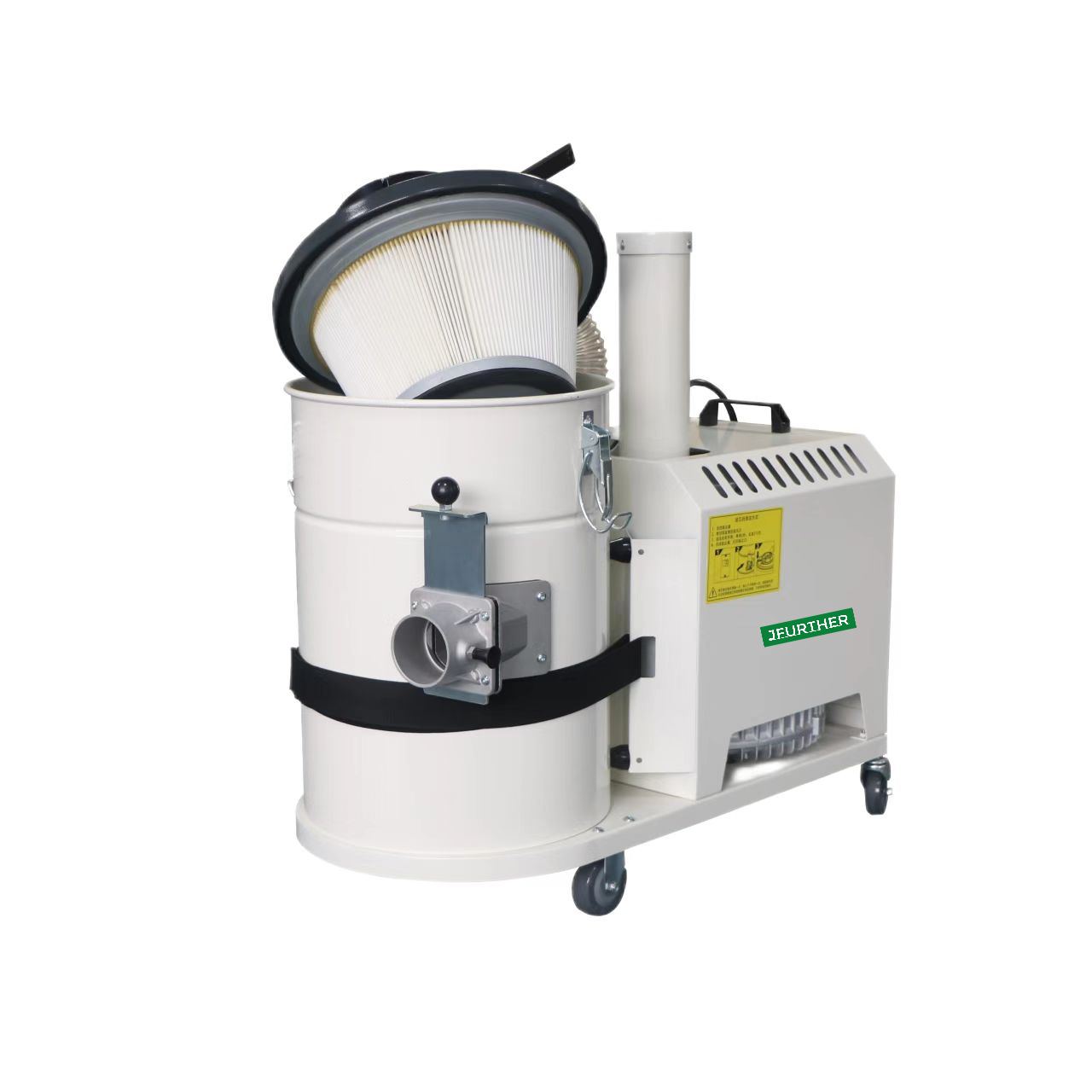
The JF3 catalog shows a D70 aluminum die-cast suction port that can use D40 and D50 vacuum kits. The JFL9 catalog lists a D50 vacuum connection and shows D70-to-D50 and D70-to-two-D40 connection options. These fittings can support one larger suction point or two smaller branches, but branch sizing must still be checked against the required simultaneous airflow.
Also confirm:
- available floor space and service clearance;
- whether the vacuum will be stationary, machine-mounted or mobile;
- hose support so robot or axis motion does not pull on the inlet;
- access for filter cleaning and dust-bin removal;
- the acceptable sound level at the operator position;
- grounding, antistatic hose and conductive components where the process requires them.
Electrical and PLC Integration
A production-line vacuum can run continuously, start with the machine, or be controlled by a timed sequence. The correct method depends on the process and the customer’s electrical standard. Before production, define the main power supply, motor protection, control voltage and the signals exchanged with the automation equipment.
Typical project requirements may include a remote start/stop command, a dry contact or relay interface, running and fault feedback, a filter-pressure alarm, an emergency-stop interlock, or a delay that clears the hose after the process stops. These functions should be confirmed as part of the customized electrical design; they are not implied as standard on every catalog model.
JF3 and JFK5 catalog configurations use Schneider electrical components with overload, overheating and short-circuit protection. The protection scheme and all external control connections should be verified against the customer’s machine and local electrical requirements.
Filtration and Dust Cleaning for Stable Suction
Stable suction is essential in automation because a gradually blocked filter can reduce capture performance even while the motor is still running. Choose the filter according to particle size, exposure risk and the required cleanliness of the discharged air.
- JF3: star-bag or selected H-class HEPA configurations, with manual vibration, blowback or electric vibration options. The catalog lists 0.3 μm filtration at at least 99.5% for the HEPA configurations.
- JFK5: HEPA, antistatic cartridge or star-bag choices, with manual blowback cleaning. The catalog lists 1.0 μm filtration above 99.5%.
- JFL9: external bag filtration or an antistatic cartridge, plus a negative-pressure gauge to help operators identify increasing filter resistance.
- JS9: PTFE-coated polyester filter and blowback cleaning, with electric vibration plus blowback on the JS903 configuration.
Filter performance is only one part of the system. The dust discharge method, gasket condition, hose connection and maintenance procedure also affect containment. For fine or hazardous material, ask for the complete filtration and disposal configuration rather than relying on a filter label alone.
Recommended Starting Point by Application
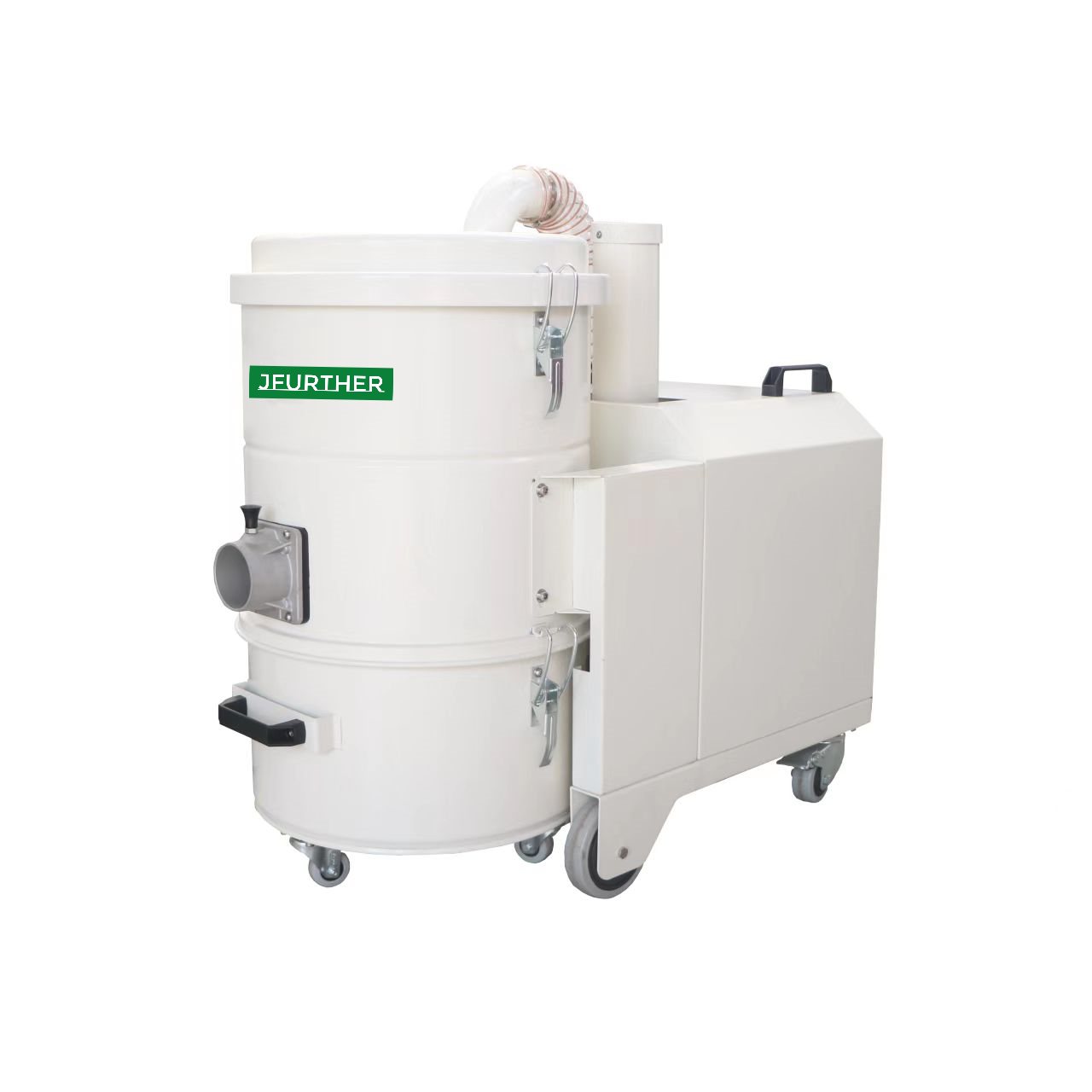
- CNC, grinding or heavier continuous debris: start with JF3 when higher vacuum, airflow and a 100 L collection volume are required.
- Packaging, pharmaceutical or precision processing equipment: start with JFK5 when a compact footprint and 1.3-3.0 kW range are priorities.
- Electronics and compact automation cells: start with JFL9 when installation space, a 30 L separable bucket and pressure monitoring are important.
- Single-phase facilities: consider JS9 when 220 V supply and high airflow are required, then confirm the intended duty cycle and control method.
These are starting points, not a substitute for a system calculation. JFURTHER can match the vacuum, filtration, inlet adapter, hose and control approach to the automated equipment.
Information Needed for an Accurate Vacuum Recommendation
To receive a faster and more accurate proposal, send the following information with your inquiry:
- material name, particle size and photos or video of the waste;
- estimated dust generation per minute or per shift;
- number and size of suction points that operate at the same time;
- hose diameter, total length, vertical lift and number of bends;
- available voltage, frequency and phase;
- required daily operating hours and start/stop frequency;
- maximum installation footprint and service-access limits;
- required filter, antistatic or containment configuration;
- required PLC, relay, alarm or interlock signals;
- any combustible-dust, hazardous-area or local compliance requirements.
Contact JFURTHER for an automation-equipment vacuum matching proposal. Our team can review the application data and recommend a practical configuration for testing and integration.
자주 묻는 질문
Can an industrial vacuum cleaner start and stop with an automated machine?
Yes, when the electrical control interface is designed for the project. The machine builder and vacuum supplier should agree on the control voltage, signal type, motor starter or contactor, feedback signals, interlocks and stop delay. Do not connect a PLC output directly to a motor without the correct control and protection hardware.
Is a three-phase industrial vacuum cleaner better for automation equipment?
A three-phase turbine vacuum is often a strong choice for continuous production because JFURTHER’s JF3, JFK5 and JFL9 catalog configurations are designed for 24-hour operation. However, the best choice still depends on airflow, vacuum, material, power availability and maintenance needs.
What is the difference between JF3, JFK5 and JFL9?
JF3 provides the broadest power range and the largest collection volume for heavier-duty systems. JFK5 is a compact 1.3-3.0 kW series intended for production-line and machine-side use. JFL9 is a 2.2 kW compact series positioned for electronics and automation applications, with a pressure gauge and flexible D50/D40 connection options.
How many machines can one industrial vacuum cleaner serve?
That depends on the airflow required at every pickup point and how many points operate simultaneously. A multi-branch system must be calculated from the hood openings, hose sizes, duct losses and material transport velocity. The number of branches alone is not enough to size the vacuum.
Can these industrial vacuum cleaners handle combustible dust?
Do not assume a standard model is suitable. Combustible dust requires a process and site hazard assessment, grounding and antistatic review, and equipment designed and documented for the applicable zone and local requirements. Provide the dust data and compliance requirement before selection.
결론
The best industrial vacuum cleaner for automation equipment is the one that maintains the required capture performance throughout the real production cycle and integrates safely with the machine. JF3 is suited to heavier-duty extraction, while JFK5 and JFL9 provide compact options for machine-side and automation-cell installation. A correct proposal should combine air-performance calculations, filtration, hose routing, collection capacity and control requirements in one system design.
Product specifications in this article are based on the JFURTHER Industrial Vacuum Cleaner Series catalog dated May 21, 2024. Available configurations may change; confirm final specifications and compliance requirements with JFURTHER before ordering.
 KO
KO  EN
EN  ES
ES  PT
PT  DE
DE  RU
RU  AR
AR  JA
JA